
Many dogs tolerate grooming rather than willingly participating, resulting in fear, struggling, aggression, reduced welfare and increased injury risk for both the dog and the grooming team. Cooperative care and consent-based grooming shift the focus from physical restraint to communication, predictability and voluntary participation.
This session explores how understanding canine body language, stress responses and learning theory can transform everyday grooming. Participants will learn how to recognise early signs of stress, build trust through predictable handling, teach simple consent behaviours, use strategic reinforcement, and adapt grooming techniques to individual patients. Practical solutions for common challenge will be discussed evidence-based techniques that improve safety, efficiency and client satisfaction while helping dogs become increasingly confident and cooperative during future grooming visits.
This webinar is sponsored by Stress Free Pets
Speaker:
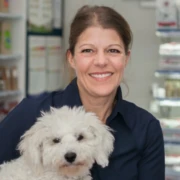
Isabelle Resch
DVM, BVSc, MVS, MANZCVS (Small Animal Medicine, Vet Behaviour)
Isabelle graduated from the University of Sydney and has worked in small animal practice since then. She completed a Master of Veterinary Studies and Membership in Small Animal Medicine in 2001. Isabelle passed her Membership examinations in Veterinary Behaviour in 2016 and is currently undertaking a residency in Behavioural Medicine with the Australian and New Zealand College of Veterinary Scientists and the American College of Veterinary Behaviour, on the pathway to becoming a Veterinary Behavioural Medicine specialist.
Isabelle is a tutor for the Distance Education programme in Veterinary Behaviour, University of Sydney, a consultant for the Veterinary Information Network (VIN) in Behaviour and has been an examiner for the Australia New Zealand College of Veterinary Scientists. She is the current President of AVBM (Australian Veterinary Behavioural Medicine), a special interest group of the Australian Veterinary Association (AVA).
She attends several national and international behaviour conferences every year and is passionate about providing ongoing education to help to continue growing and developing the field of veterinary behaviour. She currently works at Canberra Animal Behaviour Solutions at the Animal Referral Hospital in Canberra.