
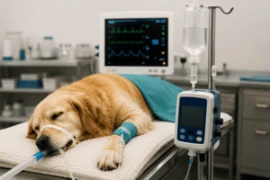
Total intravenous anaesthesia consists of providing general anaesthesia using only intravenous-based agents. Those differ with species and the cost. While in equine patients, ketamine-based anaesthesia is most common, propofol and, more recently, alfaxalone have taken the lead in small animals. To minimise the quantity of agents used and associated side effects, as for the inhalants, balanced anaesthesia is essential and analgesic agents and muscle relaxants are added as required. Different administration methods have been developed since the use of intravenous agents, going from the simple bolus injection and the constant rate infusion to the more complicated pharmacokinetically-based and computer-driven target-controlled infusion system.
Speaker:

Thierry Beths
Associate Professor, DVM
Associate/Prof Thierry Beths joined the University of Melbourne (UoM) Veterinary Hospital in February 2012, working in the Anaesthesia and Analgesia department. He did a residency in Veterinary Anaesthesia and Analgesia at the University of Glasgow (UK) from 1997to 2000. In 2008, he obtained from the same University a PhD on developing a Target Controlled Infusion (TCI) system for propofol in dogs.
He has a strong interest in animal welfare and pain management. He is the chair of one of the UoM Melbourne Animal Ethic committee (since 2016) and a Cat A member (since 2014) for the Wildlife Small Industry AEC (Agriculture Victoria). He is an active member (since 2018) of the Animal Welfare Advisory Committee (Agriculture Victoria).
He has a certification (CVA) in Veterinary Acupuncture from the Chi Institute and China National Society of TCVM, Florida (USA), and a certification (CVPP) of Veterinary Pain Practitioner from the International Veterinary Association of Pain Management (IVAPM). In 2020, he graduated from the University of Edinburgh (UK) with an MSc (Dist.) in Clinical Pain Management. He recently started training in Canine Rehabilitation through the University of Tennessee (USA) and hopes to graduate as a Canine Rehabilitation Practitioner (CCRP) by the end of 2026.